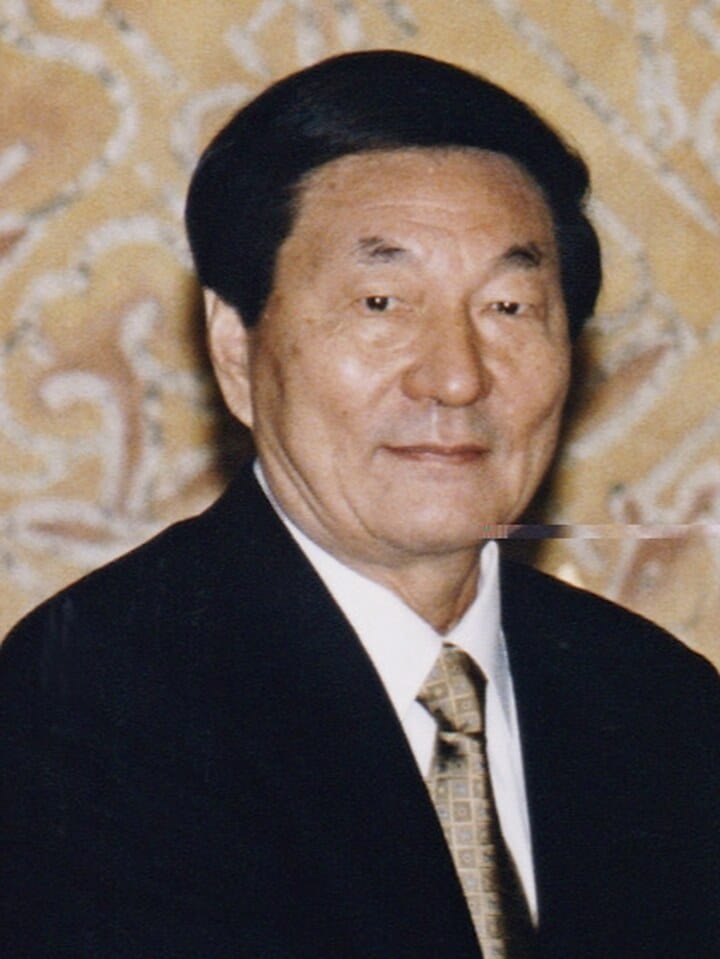

Wang Xiji, a Chinese aerospace engineer who helped create China’s independent space capability, died in Beijing on Aug. 12, 2026, at 105, according to The Paper.
After earning a science master’s degree in the United States, Wang returned to China in 1950. He taught at Dalian Institute of Technology and wrote engineering textbooks before being transferred to Shanghai in November 1958 to lead sounding-rocket work. Wang and his team successfully launched T-7M on Feb. 19, 1960, China’s first sounding rocket, a research rocket that carries instruments into the upper atmosphere.
Wang next formulated the overall technical plan for Long March 1 and led its preliminary development. The launch vehicle combined missile and sounding-rocket technology and later launched Dong Fang Hong-1, China’s first satellite, on April 24, 1970. He then became chief designer of China’s first recoverable satellite. He adopted a return-to-Earth design centered on a large common return capsule. The satellite launched on Nov. 26, 1975, returned three days later and made China the third country to master satellite-return technology.
In 1987, Wang was chief designer of China’s ninth recoverable satellite. He oversaw the country’s first recoverable-satellite mission carrying an experiment for a foreign partner. The mission paired a French experiment to grow protein crystals with a Chinese experiment to grow gallium-arsenide crystals. The satellite returned five days later, and both experiments succeeded.
Before China formally established its crewed-spaceflight project in 1992, Wang was a senior space-technology leader who argued that an expensive reusable shuttle did not fit the country’s conditions. His position helped steer experts toward crewed spacecraft. The project was later named Shenzhou.
In 2006 and 2007, Wang Xiji and fellow engineer Wang Liheng, a member of the Chinese Academy of Sciences, co-led work to prepare the implementation plan for China’s high-resolution Earth-observation system. The plan helped the project obtain national approval and enter development in 2007.