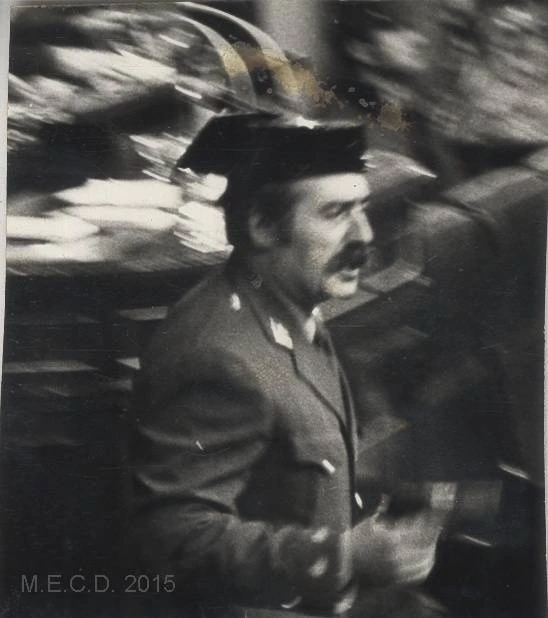
Antonio Tejero, the Spanish Guardia Civil lieutenant colonel who became the public face of the failed Feb. 23, 1981, coup attempt known as 23-F, died Feb. 25, 2026, in Alzira, Valencia. He was 93. His family said he died accompanied by his children and after receiving the last sacraments. The cause of death was undisclosed.
Tejero’s defining act came during Spain’s democratic transition after the death of Gen. Francisco Franco. On the evening of Feb. 23, 1981, as lawmakers gathered in the Congress of Deputies for the investiture vote of Leopoldo Calvo-Sotelo, Tejero entered the chamber with about 200 Guardia Civil officers and seized control of the session, in an attempt to derail the transfer of power.
Spanish courts later convicted him of military rebellion for his role in the plot. On June 3, 1982, he was sentenced to 30 years in prison. He was released in 1996 after serving about half that term.
His name had surfaced earlier in connection with another destabilization effort: the 1978 attempted putsch known as Operation Galaxia, which was widely viewed as an early sign of resistance within parts of the security apparatus to Spain’s new democratic framework.
After leaving prison, Tejero remained a polarizing figure, continuing to appear in Francoist-associated circles, including protests around the 2019 exhumation and reburial of Franco. For many Spaniards, his legacy is inseparable from 23-F, an episode that tested the strength of the country’s young constitutional order and shaped how its institutions responded to threats against civilian rule.